

Thyroid Blood Tests Explained: TSH, T3, T4 and Thyroid Antibodies
Thyroid blood tests can show whether the thyroid is producing the right amount of hormone and, in some cases, help identify the cause of a thyroid problem.
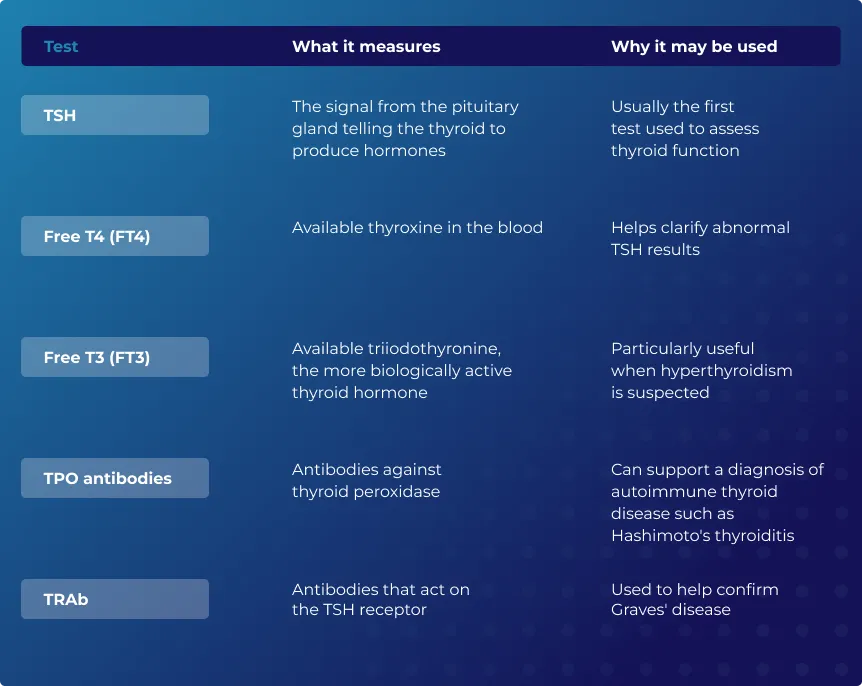
However, TSH, T3, T4 and thyroid antibody tests do not all provide the same information, and they are not routinely requested together for every patient.
For most adults, testing usually starts with thyroid-stimulating hormone (TSH). Depending on the result, symptoms and clinical circumstances, free T4, free T3 or thyroid antibody tests may then be needed.
This means that having only a TSH result does not necessarily mean that thyroid testing is incomplete. Likewise, a result outside the laboratory reference range does not automatically confirm a thyroid condition or explain every symptom.
This article explains what the main thyroid blood tests measure, why each one may be requested, and how the results are interpreted together.
Thyroid Blood Tests at a Glance
What Are Thyroid Blood Tests?
Thyroid blood tests help assess how the thyroid system is working and, when needed, whether an autoimmune condition may be involved.
The pituitary gland releases thyroid-stimulating hormone (TSH), which signals the thyroid to produce the hormones thyroxine (T4) and triiodothyronine (T3). As thyroid hormone levels rise or fall, the pituitary adjusts TSH in response.
This feedback system is why thyroid test results are usually interpreted together rather than as individual numbers.
It is also useful to distinguish between thyroid function tests, such as TSH, FT4 and FT3, and thyroid antibody tests. Function tests show how the thyroid system is working, while antibody tests can help identify whether an autoimmune condition may be contributing to thyroid disease.
Thyroid blood tests are also part of a wider range of endocrine tests used to assess hormone levels and the function of glands such as the thyroid, pituitary and adrenal glands.
However, blood tests do not detect every type of thyroid problem. A thyroid lump or swelling, for example, can be present even when TSH and thyroid hormone levels are normal. Structural changes may therefore require separate assessment, such as a clinical examination or ultrasound.
What Does a TSH Blood Test Measure?
TSH is usually the first blood test used to check thyroid function. It shows how strongly the pituitary gland is signalling the thyroid to produce thyroid hormones.
When circulating thyroid hormone levels fall, the pituitary usually responds by producing more TSH to stimulate the thyroid. When thyroid hormone levels rise, TSH usually falls.
In general:
- a raised TSH may suggest that the thyroid is underactive and not producing enough hormone
- a low TSH may suggest that the thyroid is overactive or that too much thyroid hormone is circulating.
However, TSH should not be interpreted on its own when it falls outside the reference range.
Current NICE guidance recommends measuring TSH first in most adults when a pituitary disorder is not suspected. If TSH is above the laboratory reference range, free T4 is usually measured. If TSH is below the reference range, free T4 and free T3 are usually measured.
This step-by-step approach avoids unnecessary testing while ensuring additional tests are added when needed.
There are exceptions. If a problem involving the pituitary gland is suspected, both TSH and free T4 are generally measured because TSH alone may not accurately reflect thyroid function.
What Does T4 Tell You About Thyroid Function?
T4, or thyroxine, is the main hormone produced by the thyroid. Measuring free T4 helps show how much thyroid hormone is available for the body to use.
Most T4 in the bloodstream is attached to proteins. A smaller proportion circulates freely and is available to tissues, which is why laboratories commonly measure free T4 (FT4) rather than total T4.
FT4 is especially useful when TSH is outside the reference range because it helps show whether the thyroid is producing too much or too little hormone.
It can also provide important information when a pituitary gland disorder is suspected. In this situation, FT4 is interpreted alongside TSH because TSH alone may not accurately reflect thyroid function.
What Does a T3 Blood Test Show?
T3 is the more biologically active thyroid hormone, but it is not needed in every thyroid assessment.
Much of the body’s T3 is produced when T4 is converted into T3 in other tissues. Measuring free T3 (FT3) can be particularly useful when an overactive thyroid is suspected.
In some cases of hyperthyroidism, T3 may be raised even when T4 is still within the reference range. This can make FT3 helpful when symptoms or other test results suggest an overactive thyroid.
T3 is generally less useful when investigating hypothyroidism because levels can remain within the reference range even when thyroid function is reduced.
This is why it can be entirely appropriate for a patient to have TSH and FT4 measured without T3 being included. The aim is to order the tests that are clinically useful rather than every available thyroid test.
What Do Thyroid Antibody Tests Show?

Thyroid antibody tests can help identify whether an autoimmune process may be contributing to a thyroid disorder. They do not directly show whether the thyroid is currently overactive or underactive.
Thyroid Peroxidase Antibodies
Thyroid peroxidase antibodies (TPOAb) are commonly associated with autoimmune thyroid disease, particularly Hashimoto’s thyroiditis.
They may also be present in some people with Graves’ disease. If TSH remains raised, TPO antibody testing can help show whether autoimmune thyroiditis may be the underlying cause.
A positive result does not show how well the thyroid is functioning on its own, so TSH and thyroid hormone levels remain important.
Current UK guidance supports considering TPO antibody testing in adults with a raised TSH. Once measured, TPO antibodies usually do not need routine repeat testing.
Thyroglobulin Antibodies
Thyroglobulin antibodies (TgAb) can also occur in autoimmune thyroid disease, including Hashimoto’s thyroiditis.
They may be found alongside other thyroid antibodies, but they usually provide less additional information than TPO antibodies when investigating an underactive thyroid. For this reason, TgAb testing is not routinely needed for every patient.
TSH Receptor Antibodies
TSH receptor antibodies (TRAb) are mainly used when Graves’ disease is suspected as the cause of an overactive thyroid.
In Graves’ disease, these antibodies stimulate the thyroid to produce excess thyroid hormone. A TRAb test can therefore help distinguish Graves’ disease from other causes of hyperthyroidism.
Current UK guidance recommends TRAb testing to help confirm Graves’ disease in adults with thyrotoxicosis. The result is interpreted alongside TSH, free T4, free T3 and the wider clinical picture.
How Are TSH, T4 and T3 Results Interpreted Together?
Thyroid blood test results are usually interpreted together because the pattern of TSH, free T4 and free T3 can give a clearer picture of how the thyroid is functioning than any individual result.
Some common patterns include:
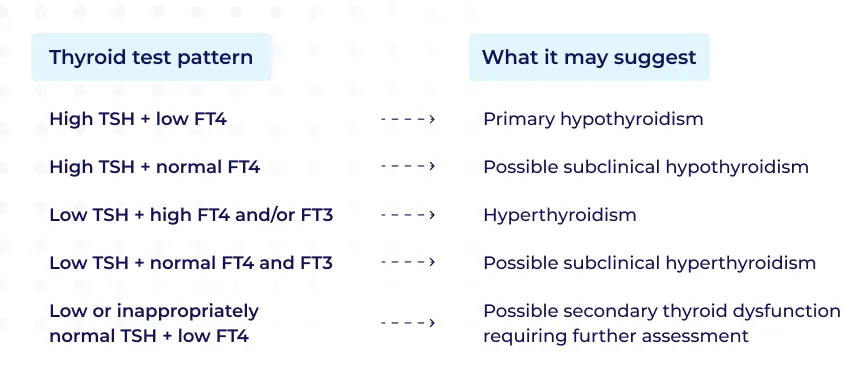
These patterns are useful for understanding thyroid tests, but they should not be used for self-diagnosis.
Previous results, symptoms, medication, pregnancy, other medical conditions and the reason testing was requested all affect interpretation. In some cases, especially when an abnormality is mild, repeating the blood test may be more appropriate than making an immediate treatment decision.
This is particularly relevant because thyroid-related symptoms such as fatigue, weight changes, palpitations, menstrual changes and difficulties concentrating can have many different causes and do not always point to thyroid disease.
Thyroid results may also need to be interpreted differently at certain stages of life. This guide to thyroid disease in women explains how thyroid problems can overlap with reproductive changes, pregnancy, the postnatal period and menopause.
Why Do Thyroid Reference Ranges Differ?
Thyroid results should be interpreted using the reference range provided by the laboratory that performed the test rather than a general range found online.
Reference ranges can vary because laboratories may use different analysers, testing methods and populations when establishing them. Pregnancy, age and other clinical factors can also affect how thyroid results are interpreted.
For this reason, TSH, FT4 and FT3 results should always be considered alongside the reference range shown on your own laboratory report. A value that falls outside a range quoted online does not necessarily fall outside the reference range used by the laboratory that tested your sample.
The British Thyroid Foundation also advises that published thyroid ranges are general guides and can vary between laboratories. For patients having repeat thyroid tests, changes over time should be considered alongside symptoms, treatment and the wider clinical context.
What Can Affect Thyroid Blood Test Results?
Thyroid blood test results can be influenced by medicines, supplements, pregnancy, significant illness and recent thyroid treatment, so an unexpected result does not always mean that thyroid function has changed.
One important example is biotin, also known as vitamin B7. It is found in some hair, skin and nail supplements and can interfere with certain thyroid tests, potentially producing falsely high or falsely low results.
Pregnancy can also affect thyroid hormone levels and how results are interpreted. Significant illness and some medicines may influence thyroid tests as well.
Results may also need careful interpretation after treatment for hyperthyroidism because TSH can take time to reflect changes in circulating thyroid hormone levels.
Thyroid blood test results should always be interpreted in the context of the patient’s overall health, medication, supplements and other relevant clinical factors.
Do You Need to Prepare for a Thyroid Blood Test?

Most thyroid blood tests require very little preparation, but you should follow any instructions provided by your doctor or laboratory.
You usually do not need to fast for thyroid testing alone, although fasting may be required if other blood tests are being taken at the same appointment.
Before the test, tell the clinic about any thyroid medication, antithyroid medicines, biotin-containing supplements and other medicines or supplements you take. Also mention if you are pregnant or may be pregnant.
Do not stop or change medication or supplements unless you have been specifically advised to do so. If you are unsure what to take before the test, check with the clinic beforehand.
When Are Thyroid Blood Tests Repeated?
How often thyroid blood tests need to be repeated depends on why they were requested, the results and whether treatment has recently started or changed.
An abnormal result does not always need to be checked again straight away. When thyroid dysfunction is still being investigated, repeat testing may be appropriate if symptoms worsen or new symptoms develop, but it is generally not repeated sooner than six weeks after the previous test.
Once treatment has started, monitoring depends on the condition and medication. For adults taking levothyroxine for primary hypothyroidism, TSH may be checked every few months until levels are stable and then usually once a year.
Antibody tests are different and generally do not need routine repeat monitoring.
When Should You See an Endocrinologist?

You may benefit from seeing an endocrinologist if your thyroid results remain abnormal, are difficult to interpret, do not match the symptoms or suggest a more complex thyroid disorder.
Specialist assessment may be helpful if you have:
- persistently abnormal thyroid results
- suspected Graves’ disease or more complex hyperthyroidism
- possible pituitary-related thyroid dysfunction
- symptoms and blood results that do not fit the expected pattern
- difficulty achieving stable thyroid control with treatment
- thyroid disease during pregnancy or alongside other endocrine conditions
- uncertainty about antibody results or whether further tests are needed
Many common thyroid conditions can be diagnosed and managed in primary care. An endocrinologist is more likely to be helpful when diagnosis or treatment is less clear or additional endocrine expertise is needed.
Conclusion
Thyroid blood test results are most useful when they are interpreted together rather than as individual numbers.
TSH is usually the starting point, while FT4, FT3 and thyroid antibody tests can provide additional information when needed.
An abnormal result does not always mean that treatment is required or explain every symptom. If your results remain abnormal, are unexpected or do not match how you feel, speak with your doctor about whether repeat testing or further assessment is appropriate.
Thyroid Testing and Endocrinology at London Lauriston Clinic
London Lauriston Clinic, a private health clinic in London, offers specialist care for thyroid gland disorders.
Its consultant endocrinologists can review thyroid blood test results, investigate results that remain abnormal or are difficult to explain, and advise on any further testing, monitoring or treatment that may be needed. Thyroid profile blood tests are also available through the clinic’s endocrinology services.
To arrange an endocrinology consultation at London Lauriston Clinic, contact info@llclinics.co.uk or call 020 4511 0444.
FAQs About Thyroid Blood Tests
Which blood tests are used to check thyroid function?
Testing usually starts with TSH. Depending on the result and clinical circumstances, free T4, free T3 or thyroid antibody tests may also be needed.
What symptoms might lead to thyroid testing?
Symptoms can include persistent tiredness, unexplained weight changes, sensitivity to heat or cold, palpitations, changes in mood or concentration, and menstrual changes. These symptoms have many possible causes, so thyroid testing is considered alongside the wider clinical picture.
Can stress affect thyroid test results?
Stress can cause symptoms that overlap with thyroid problems, such as tiredness, sleep difficulties or changes in heart rate. However, an abnormal thyroid blood test should not automatically be attributed to stress. Significant illness can also affect thyroid results, so they should always be interpreted in context.
Do I need to fast before a thyroid blood test?
Usually not if thyroid testing is being done on its own. Fasting may be required if other blood tests are being taken at the same appointment, so follow the instructions provided by your doctor or laboratory.
What does an abnormal TSH result mean?
A high or low TSH can suggest that the thyroid is underactive or overactive, but TSH is usually interpreted alongside free T4, free T3 when needed, symptoms and medical history.
Do thyroid antibody levels need to be checked regularly?
Usually not. Thyroid antibody tests can help identify an autoimmune cause, but ongoing monitoring and treatment are generally guided by thyroid function tests such as TSH and free T4.
Can thyroid blood tests detect thyroid nodules or thyroid cancer?
Not reliably. Thyroid blood tests assess thyroid function, but normal TSH or T4 levels do not rule out a thyroid nodule or thyroid cancer. A lump or other structural thyroid concern usually needs separate assessment, which may include examination and an ultrasound.