
Cardio-Metabolic Analysis: How the Test Works and What It Measures
Daria Ovuka outlines how cardio-metabolic analysis works, what it measures, and how this integrated assessment evaluates cardiovascular fitness, metabolic health, and physiological recovery.
Cardio-metabolic analysis is a non-invasive assessment that evaluates the integrated function of the cardiovascular, respiratory, metabolic, and autonomic nervous systems. By analysing breathing gases, heart rate dynamics, and recovery responses, it provides an objective view of cardiovascular fitness, metabolic health, and physiological resilience.
The assessment consists of two components:
- A resting cardio-metabolic test – assessing baseline metabolic function, breathing efficiency, and autonomic regulation at rest.
- An active cardio-metabolic exercise test – including warm-up, graded exercise, and recovery
Together, these tests assess how the body functions at rest, responds to controlled physiological stress, and recovers following exertion. In total, the analysis captures a comprehensive panel of 23 physiological and metabolic biomarkers.
Resting Cardio-Metabolic Test
(Seated or Supine Assessment)
During the resting test, the individual sits or lies in a supine position while breathing through a face mask connected to specialised gas-analysis equipment. Heart rate is continuously monitored via a chest strap secured across the chest, allowing precise tracking of cardiac response throughout the test.
This 10-minute assessment evaluates baseline metabolic function, respiratory mechanics, and autonomic nervous system regulation under minimal physiological demand.
Key parameters measured include:
Resting Metabolic Rate (RMR)
RMR represents the measured energy required to sustain essential physiological processes at rest. It is calculated using oxygen consumption and carbon dioxide production.
This provides an individual-specific baseline for daily energy needs and supports personalised nutrition, weight management strategies, and lifestyle interventions.
Variations in RMR may reflect metabolic adaptation, hormonal influences, body composition, chronic stress, or prolonged under- or over-fuelling.
Autonomic Nervous System Activity
Markers associated with parasympathetic (rest-and-digest) and sympathetic (stress-related) nervous system activity are assessed. Autonomic balance plays a central role in cardiovascular regulation, metabolic health, and recovery capacity.
Persistent sympathetic dominance or reduced parasympathetic activity is commonly observed in individuals with chronic stress, sleep disruption, reduced recovery capacity, or increased cardiometabolic risk.
Heart Rate Variability (HRV)
Heart rate variability provides insight into autonomic flexibility and cardiovascular adaptability. Reduced HRV has been associated with impaired stress resilience, reduced recovery capacity, and elevated cardiometabolic risk.
Respiratory Mechanics at Rest
The resting test measures key parameters related to breathing efficiency and ventilatory control, including:
- Respiratory rate (RR) – breathing frequency at rest
- Tidal volume (VT) – the volume of air inhaled and exhaled with each passive breath
- Oxygen uptake (VO₂) – the rate at which oxygen is consumed
- Carbon dioxide production (VCO₂) – the rate at which carbon dioxide is produced
These measures provide insight into baseline breathing patterns, ventilatory efficiency, and respiratory workload at rest. VO₂ and VCO₂ also contribute to the assessment of metabolic activity and substrate utilisation.
Metabolic Markers Derived from Gas Exchange
Metabolic markers are derived from the analysis of oxygen consumption and carbon dioxide production and provide insight into how energy is produced at rest:
- Respiratory exchange ratio (RER) – indicating the relative contribution of fat and carbohydrate metabolism
- Resting fat oxidation – reflecting the body’s ability to utilise fat as a primary fuel source at rest
- Metabolic flexibility – the capacity to appropriately shift between fat and carbohydrate metabolism based on physiological demand
Reduced fat oxidation or impaired metabolic flexibility at rest may indicate early metabolic dysfunction or stress-related metabolic adaptation.
Active Cardio-Metabolic Exercise Test
(Warm-Up, Graded Ramp, and Recovery)
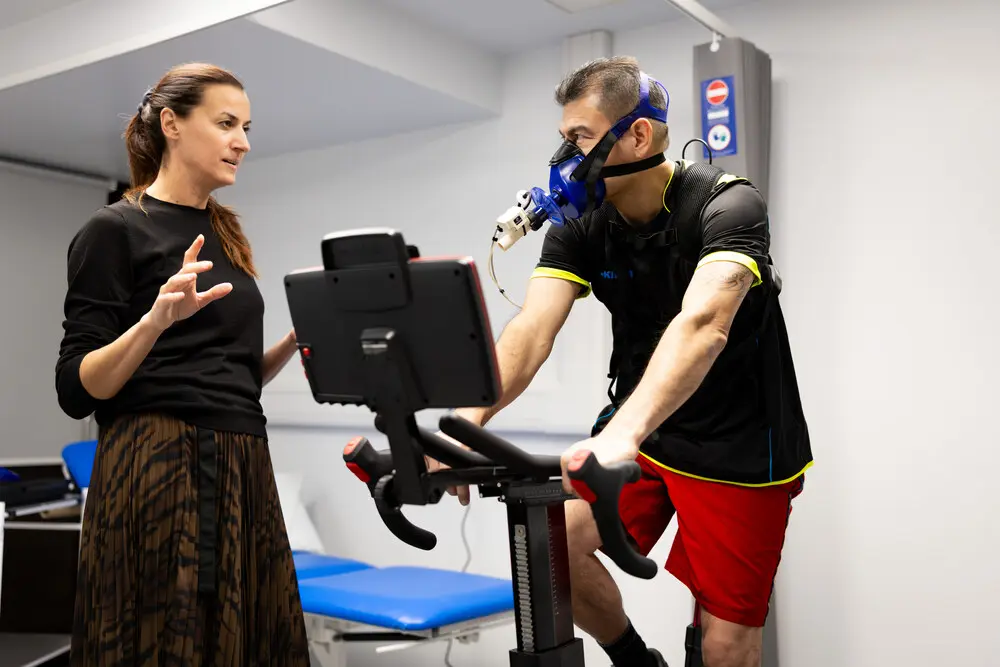
The active test evaluates physiological responses to progressively increasing exercise intensity. Testing is performed on a treadmill or cycle ergometer with continuous gas exchange and heart rate monitoring.
Phase 1: Warm-Up (3 Minutes)
This phase provides a gradual and controlled transition from rest to activity. Early changes in heart rate, breathing, and oxygen uptake offer insight into cardiovascular efficiency, movement economy, and overall readiness for exercise.
Phase 2: Graded Ramp Exercise (9-12 Minutes)
Workload increases progressively until volitional fatigue or a clinically appropriate endpoint is reached. This phase assesses functional capacity and peak physiological performance.
Aerobic Capacity (VO₂ Max)
VO₂ max represents the maximum capacity of the body to transport and utilise oxygen during sustained, high-intensity exercise. It is a gold-standard measure of integrated cardiovascular, respiratory, and muscular oxidative function.
VO₂ max provides insight into:
- Cardiovascular efficiency and cardiac output
- Pulmonary oxygen delivery and ventilatory efficiency
- Skeletal muscle oxygen extraction and metabolic capacity
Lower-than-expected VO₂ max may reflect one or more of the following:
- Cardiovascular limitations (e.g., reduced stroke volume or cardiac output)
- Respiratory limitations (e.g., ventilatory inefficiency or gas exchange abnormalities)
- Reduced muscular oxidative capacity or mitochondrial function
- Overall metabolic inefficiency
VO₂ max is widely used as a predictor of functional capacity, endurance performance, and long-term cardiometabolic health outcomes.
Cardiac and Respiratory Responses to Exercise
During the graded ramp exercise, continuous monitoring captures the following key physiological responses:
- Heart rate response – how efficiently heart rate increases with rising workload and how quickly it recovers after exercise
- Stroke volume and cardiac output trends – inferred from heart rate behaviour and oxygen uptake dynamics
- Ventilation (VE) and breathing patterns – changes in respiratory rate and tidal volume as exercise intensity increases
- Oxygen uptake (VO₂) and carbon dioxide production (VCO₂) – used to evaluate oxygen utilisation, energy production, and substrate metabolism
Analysis of these responses allows assessment of:
- Cardiovascular efficiency – the ability of the heart and circulation to deliver oxygen to working muscles
- Pulmonary efficiency – how effectively the lungs support oxygen uptake and carbon dioxide removal
- Metabolic performance – whether skeletal muscles use oxygen efficiently to produce energy
Abnormal response patterns may indicate:
- Blunted or exaggerated heart rate response, suggesting autonomic imbalance, cardiovascular limitation, or physical deconditioning
- Early ventilatory threshold or abnormal VE/VO₂ ratios, indicating respiratory inefficiency or reduced aerobic capacity
- Low oxygen uptake relative to workload, suggesting impaired muscular oxidative metabolism or mitochondrial limitation
This detailed assessment helps identify physiological limitations that may not be evident at rest, supporting targeted exercise prescription, metabolic optimisation, and lifestyle interventions.
Individualised Training and Intensity Thresholds
Physiological thresholds are used to define personalised training zones for fat burning, aerobic conditioning, and performance optimisation. These zones can be tracked using compatible apps or wearable devices.
Energy Expenditure and Substrate Utilisation During Exercise
Metabolic rate and fuel utilisation are measured across increasing workloads, allowing assessment of:
- Fat-burning efficiency during exercise
- The transition from fat-dominant to carbohydrate-dominant metabolism
- Overall metabolic cost of physical activity
These insights support targeted interventions for improving metabolic health, weight management, and cardiovascular conditioning.
Phase 3: Recovery Analysis (3 Minutes)
The recovery phase evaluates how efficiently physiological systems return toward baseline following exertion.
Cardiovascular and Autonomic Recovery
The rate at which heart rate declines and respiratory parameters normalise provides insight into autonomic regulation and cardiovascular resilience. Faster recovery is generally associated with better physical conditioning and stress adaptability.
Delayed recovery may reflect reduced fitness, elevated stress load, or impaired autonomic function.
Post-Exercise Metabolic Flexibility
The ability to shift back toward fat utilisation after exercise reflects metabolic resilience and energy system adaptability, which are key determinants of long-term cardiometabolic health.
Post-Test Analysis and Recommendations
After the resting and active cardio-metabolic tests, the collected data are analysed to create a comprehensive physiological profile. This profile highlights individual strengths, limitations, and areas for improvement across metabolism, cardiovascular fitness, and recovery capacity.
Based on the findings, personalised recommendations may include:
- Exercise prescription and training zones – Using precise physiological thresholds identified during the ramp test, individualised training zones are defined to optimise fat burning, cardiovascular conditioning, and overall performance. These zones can be monitored using compatible apps or wearable devices to track training intensity and adherence.
- Nutrition and dietary guidance – Recommendations are tailored to support metabolic flexibility, improve substrate utilisation, and meet measured energy requirements (RMR), with macronutrient distribution aligned to exercise demands.
- Lifestyle and recovery strategies – Insights from autonomic function, heart rate variability (HRV), and recovery data inform stress management, sleep optimisation, and recovery protocols.
- Cardiometabolic monitoring and retesting – Progress is monitored over time, with repeat testing allowing reassessment of physiological adaptations and refinement of exercise, nutrition, and lifestyle interventions to support long-term cardiometabolic health.
This structured, data-driven approach enables targeted interventions that address specific physiological limitations, supporting improved health outcomes, performance, recovery, and reduced cardiometabolic risk.
Conclusion
Cardio-metabolic analysis offers a detailed and objective view of how the body functions at rest, responds to physical stress, and recovers afterward. By combining metabolic, cardiovascular, respiratory, and autonomic measurements, it provides insights that are difficult to obtain through resting assessments alone.
Rather than focusing on a single marker, this approach helps identify how different physiological systems interact, highlighting early signs of inefficiency, reduced fitness, or metabolic imbalance. These insights can support more informed decisions around exercise, nutrition, and lifestyle, whether the goal is health optimisation, performance improvement, or long-term cardiometabolic risk reduction.
If you would like to explore whether cardio-metabolic analysis is appropriate for your individual health goals, the team at the London Lauriston Clinic can provide further guidance and discuss how this assessment may fit within a personalised care plan.
This article was written by Daria Ovuka, a Cardiac Specialist Nurse and Registered Nutritionist with over 20 years of experience in cardiac and critical care, specialising in advanced metabolic assessment and VO2 max testing.